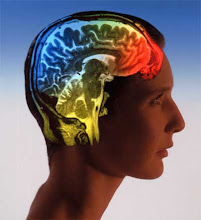
SM stands for sensory memory. It is the first stage of the multi-store model of memory. Information from the senses is stored very briefly in SM, before passing to STM if we pay attention to it.
SM is actually comprised of several stores, one for each sense. The best known are the iconic store (visual) which has a duration of around 0.5 seconds, and the echoic store (auditory/acoustic) which has a duration of around 2 seconds. These allow us to retain sights and sounds for long enough for us to tune in to them and start processing them.
A typical example of sensory memory is the way that even if we haven't been listening to someone, for example a teacher, we can still hear a kind of trace or echo in our head of what they said for a second or two, allowing us to pretend that we really were listening all along! This is the echoic store in action.
Showing posts with label models of memory. Show all posts
Showing posts with label models of memory. Show all posts
Friday, 22 January 2010


Friday, 2 October 2009
Key aspects of the WMM and MSM theories of memory
A summary of the points about these two models that I wrote on the whiteboard. This is the kind of information you should put in if asked in a test/exam to describe or explain the model(s).
MSM:
3 separate stores
Linear - info goes through each store in turn
Rehearsal is key to LTM encoding
Passive storage
WMM:
Modalities of slave systems allow two different tasks to be done at once
Flexible - info travels between slave systems, controlled by C.E.
Processing time is based on real time to do tasks (e.g. articulate words)
Active processing of everyday tasks
MSM:
3 separate stores
Linear - info goes through each store in turn
Rehearsal is key to LTM encoding
Passive storage
WMM:
Modalities of slave systems allow two different tasks to be done at once
Flexible - info travels between slave systems, controlled by C.E.
Processing time is based on real time to do tasks (e.g. articulate words)
Active processing of everyday tasks
Friday, 3 October 2008
Working Memory
I know that the Working Memory model can be hard to understand - here is a quick run through of the key points. I am also going to email you a sample essay answer on the models of memory.
 1) The model was proposed by Baddeley and Hitch in 1974
2) It is an alternative view of STM, which emphasises active processing (i.e. it doesn't see STM as a passive store of info).
3) WM is the part of our mind that we use for day-to-day tasks and problem solving
4) WM can achieve more than one task at once
5) The Central Executive is a system based on attention, and how your attention can be divided between tasks. It controls the other parts, which are known as 'slave systems'.
6) The Central Executive is modality-free, has a limited capacity, and is necessary for creative and non-routine processes.
7) Sound and language are mainly processed in the Phonological Loop, which has two parts...
8) The Articulatory Process or 'Inner Voice' is responsible for rehearsing words or numbers inside your head. It has a capacity of around two seconds. The Phonological Store is sometimes called the 'Inner Ear'.
9) The Visuo-spatial Sketchpad does routine visual processing, but is less well-researched. It is sometimes known as the 'Inner Eye'.
10) Recently, a new slave system, the Episodic Buffer, has been proposed. This is similar to Episodic LTM, except that it is temporary.
1) The model was proposed by Baddeley and Hitch in 19742) It is an alternative view of STM, which emphasises active processing (i.e. it doesn't see STM as a passive store of info).
3) WM is the part of our mind that we use for day-to-day tasks and problem solving
4) WM can achieve more than one task at once
5) The Central Executive is a system based on attention, and how your attention can be divided between tasks. It controls the other parts, which are known as 'slave systems'.
6) The Central Executive is modality-free, has a limited capacity, and is necessary for creative and non-routine processes.
7) Sound and language are mainly processed in the Phonological Loop, which has two parts...
8) The Articulatory Process or 'Inner Voice' is responsible for rehearsing words or numbers inside your head. It has a capacity of around two seconds. The Phonological Store is sometimes called the 'Inner Ear'.
9) The Visuo-spatial Sketchpad does routine visual processing, but is less well-researched. It is sometimes known as the 'Inner Eye'.
10) Recently, a new slave system, the Episodic Buffer, has been proposed. This is similar to Episodic LTM, except that it is temporary.
Subscribe to:
Posts (Atom)